[논문 리뷰] Masked Siamese Networks for Label-Efficient Learning
이번 논문은 Contrastive loss를 두 representation에 직접 적용하지 않고 prototype이라는 learnable sequence와 간접적으로 distribution을 정렬하는 방식이다.
Assran, Mahmoud, et al. “Masked siamese networks for label-efficient learning.” European conference on computer vision. Cham: Springer Nature Switzerland, 2022. https://arxiv.org/abs/2204.07141
Abstract
- Image representation learning framework Masked Siamese Networks (MSN) 제시
- Original unmasked image와 randomly masked patch의 representation 일치시키는 방식
Introduction
Masked Reconstruction
- Reconstruction loss를 최적화하기 위해서는 low-level image detail을 modeling해야 함
Classification task와 같이 semantic abstraction을 포함하는 작업에는 불필요
→ semantic recognition task를 위해 fine-tune 필요하며 low-shot에서 overfitting 유발할 수 있음
Joint-embedding
- Augmented view 간의 유사성 학습 → Invariance-based pretraining)
- Inductive bias는 일반적으로 높은 semantic level의 off-the-shelf representation 생성하지만 local structure 간과
** Masked Siamese Networks (MSNs)**
Masking된 입력의 representation과 unmask 표현의 일치
→ 암시적으로 denoise 수행
Method
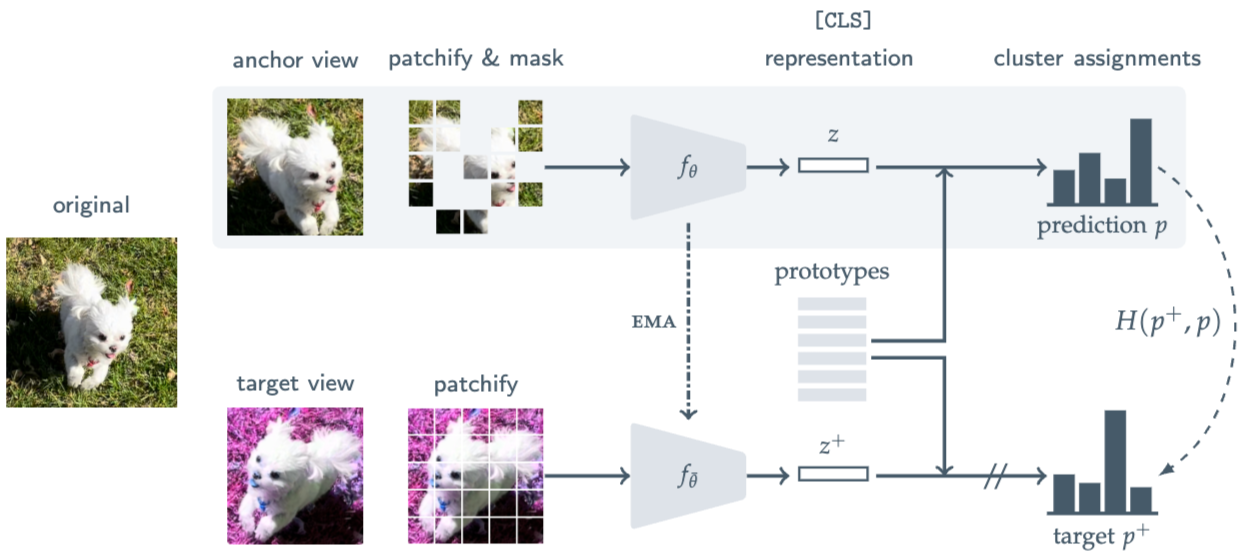
- Augmentation된 두 image 생성
- Random mask가 적용된 anchor view와 unmask 상태인 target view
- 두 view에 대해 soft distribution 계산해 두 representation을 동일한 prototype에 할당
- Prototype : Learnable vector 집합으로 image feature의 대표값
- Input representation과 prototype 간의 유사도를 softmax로 나타냄
Input Views
- B : 1개 이상의 image 포함하는 mini-batch
- x_i : batch 내의 i 번째 sample
- x^+_i : augmentation 적용된 target view
- x_{i,M} : anchor view
Patchify and Mask
- 각 view를 겹치지 않는 N \times N patch sequence로 변환 후 anchor view masking
- \hat x_{i,M} : masked anchor sequence
- \hat x^+ : masking 되지 않은 target patch sequence
→ masking 여부에 따라 두 view의 sequence 길이 다를 수 있음
Masking strategy
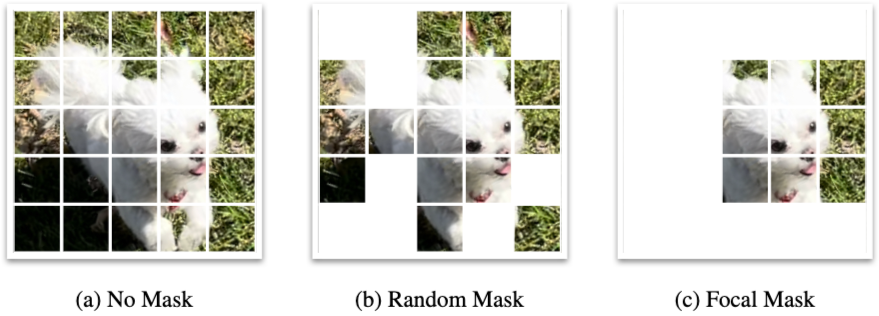
- anchor view masking 위한 두 전략
Random Mask: 무작위 patch 제거Focal Mask: anchor view의 국소적인 연속 블록 무작위 선택 이외의 patch 제거
Encoder
- ViT를 encoder로 사용하며 target encoder는 anchor encoder의 EMA 통해 업데이트
- f_{\theta}(\cdot) : anchor encoder
- z_{i,M} : masking된 anchor view로부터 계산된 representation
Similarity Metric and Predictions
- q \in \R^{K \times d} : K > 1의 Learnable prototypes, 각 prototype은 d 차원
- Encoder 학습을 위해 prototype과 anchor/target view 쌍 사이의 similarity를 기반으로 distribution 계산
- Distribution간 차이에 대해 encoder에 penalty 부여
- p_{i,M} : anchor representation과 prototype matrix q 사이의 cosine similarity 측정한 K 차원의 prediction
- p_{i,m} \in \Delta^K
- 두 view에 대해 각각 계산
Training Objective
- Anchor와 target prediction이 다를 때 penalty 부여
- Cross-entropy loss 사용
- 모델이 전체 prototype 활용하도록 장려하기 위해 평균 엔트로피 최대화 (ME-MAX) 기법 통합
아래와 같이 모든 anchor view에 걸친 평균 예측값 정의
\[\bar{p} := \frac{1}{MB} \sum_{i=1}^{B} \sum_{m=1}^{M} p_{i,m}\]ME-MAX 정규화는 p의 엔트로피인 H(p) 최대화하거나 동등하게 p의 음의 엔트로피 최소화를 목표로 하므로 아래와 같은 Objective 가짐
\[\frac{1}{MB} \sum_{i=1}^{B} \sum_{m=1}^{M} H(p_{i}^{+}, p_{i,m}) - \lambda H(\bar{p})\]→ 학습 시 target encoder는 EMA로 update 되므로 anchor의 prediction에 대해서만 gradient 계산됨
두 view의 CLS token과 learnable prototype matrix와의 similarity를 계산해 prediction을 만든 후 두 prediction 간의 cross-entropy 계산하는 방식
- Pixel level의 복원 대신 prototype space에서 두 view의 distribution 일치시켜 간접적으로 denoise
- 복원 불필요, masking으로 인한 연산량/메모리 사용량 감소
- Temperature param.과 ME-MAX 정규화 통해 representation collapse 방지
Result
- Extreme low-shot
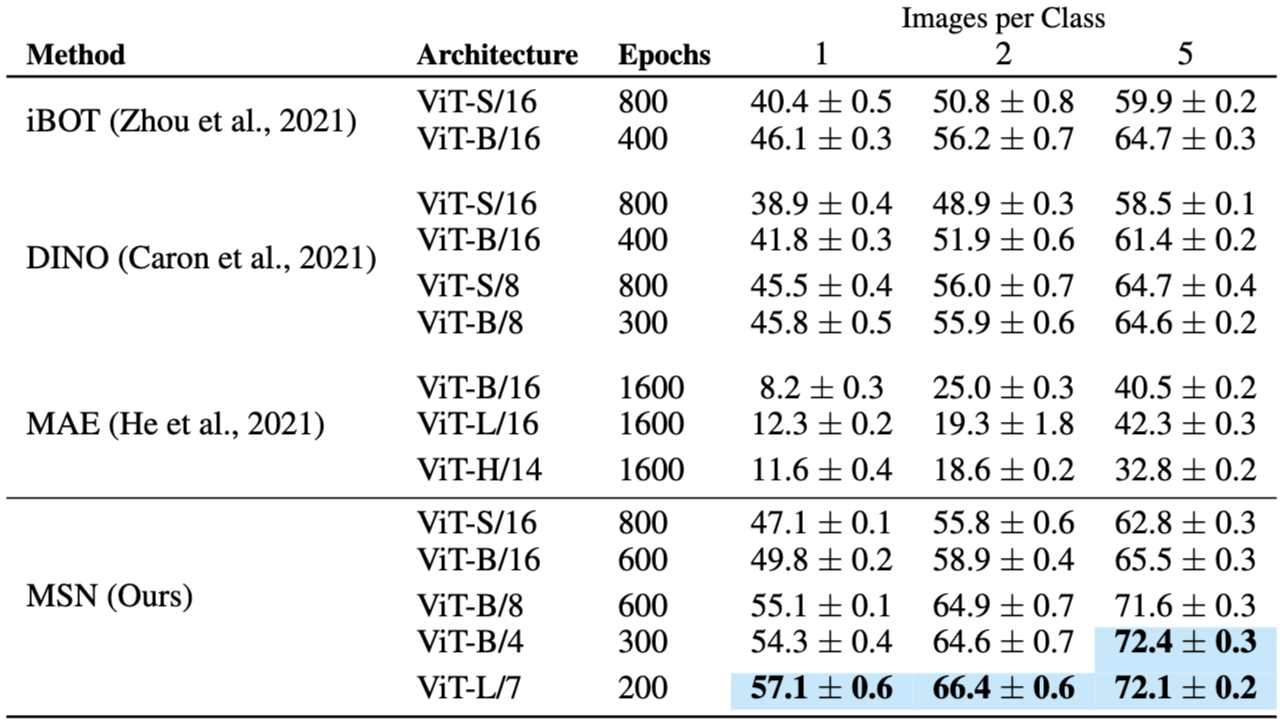
- 1% label low-shot
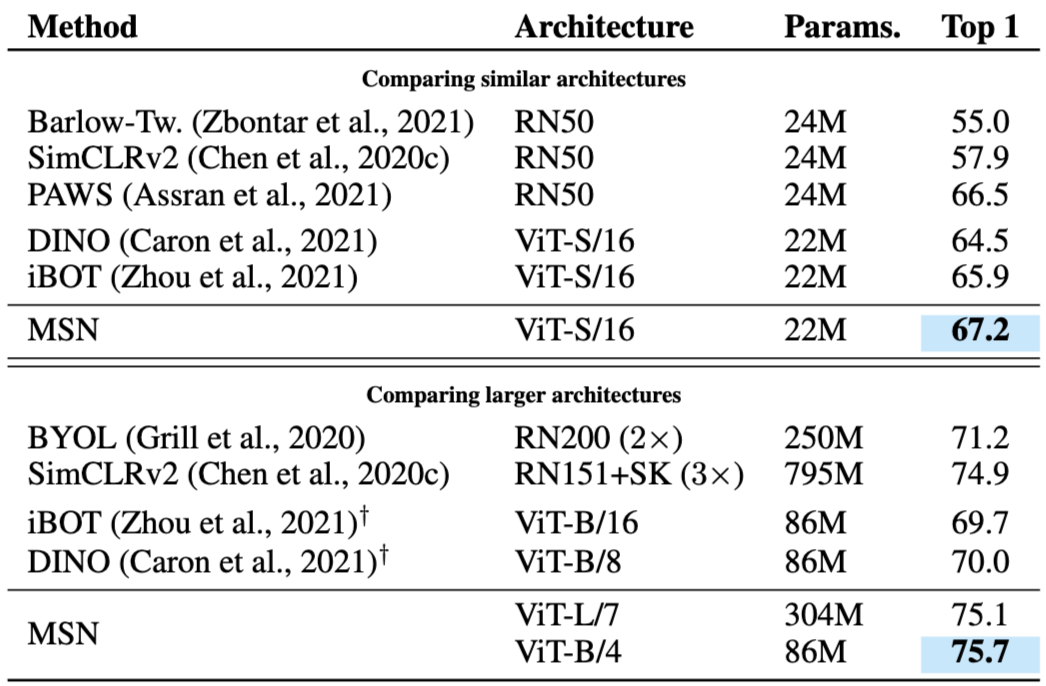
- Linprob
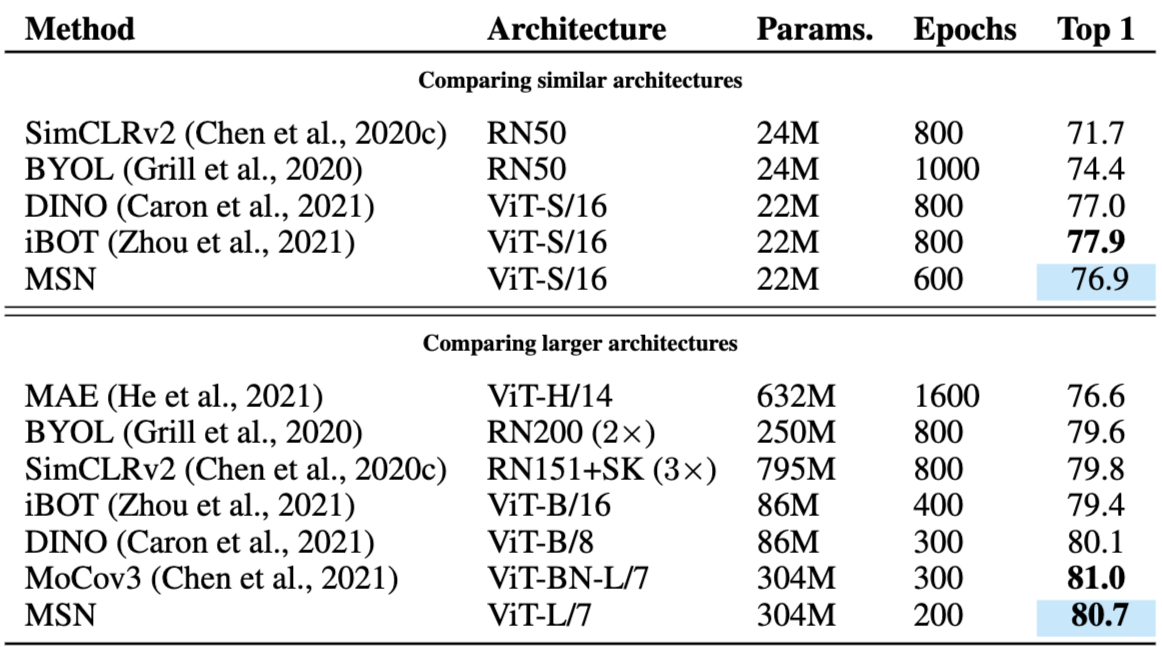
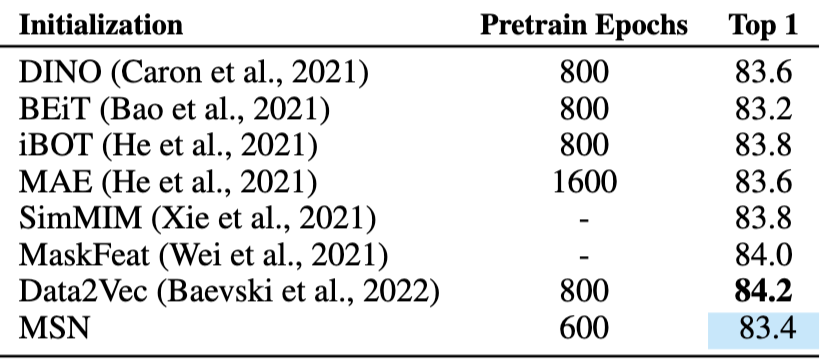
- fine-tune